Knowing how to use the FamilySearch Catalog will greatly enhance a beginner's knowledge of what is available on the FamilySearch.org website, in the Family History Library and the local Family History Centers.
Our April Beginners' Class covered a quick overview of the FamilySearch Catalog (formerly called the Family History Library Catalog), the different ways to search within the catalog, how to read a catalog entry and finally, how to download digitized books.
Here is the FamilySearch Catalog Handout which contains the links to the FamilySearch Wiki articles and other articles that go into depth on how to use the FamilySearch catalog.
The last entry on the handout, FamilySearch Catalog Exercise, is a set of questions to test your understanding of how to use the catalog.
Enjoy and thanks for attending the TCGS Beginners' Class.
Thursday, April 12, 2018

Wednesday, April 4, 2018
Family History Discovery Day at the Richland LDS Church
by Connie Estep
This four hour event on March 24th was packed with all kinds of activities. They had a large exhibit area with a wide
variety of displays. TCGS member, Janet McKinnon, displayed family history games she made for her family. She had a set of blocks that could be rearranged to show 6 different photos, one at a time. She made them by cutting each photo into squares and gluing the photo squares to the block sides with just one square per photo to each block. They were all black and white photos with people and cars. The blocks fit on a small tray that showed the 6 pictures as a guide. Another was a set of homemade cards based on the game "Authors"; each card featured a picture of an ancestor with a list of facts about them.
TCGS was represented at this event with a great display put up by Art Kelly. He included samples of various records spanning birth, military service, marriage, fraternal organizations and death. My favorite was the 1868 marriage certificate for his great-grandfather George William Kelly.
There was also a display of free genealogy handouts with info I found quite useful. One is titled “An Attempt to Answer Some Never-Ending Questions”; it includes help in sorting cousins. The “removed” cousins always puzzled me. No, they don’t divorce their families! It means two related people are in different generations. This includes a chart to make it easy to figure it out.
There was also a variety of classes. Although I helped Art at the TCGS display, I attended the story writing session where I definitely found new ideas!
The exciting part of the event for me was the “Coaches Corner”. I needed help finding information on my maternal grandfather and brought the little info I had to help. These grandparents were probably divorced at least by the time my mother was 6. She had given us a few details of her father (height 6’6”, shoe size 17). I had two records showing him: my mother’s birth certificate with his age and birth state and a Yakima City Directory entry giving a middle initial. Brian and David McShane were my coaches and great at negotiating on-line searches. They were able to locate a death record for him (we had never known his birth and death info before), a census record when he was 16, a WWI draft registration record giving his middle name (very helpful with a name like Robert Carson!), plus two employment records. This was a wealth of information compared to what I had before!
I am hoping with these clues to locate marriage and divorce records for this grandmother who was
incredibly unlucky in love! She moved with her family from West Virginia to Washington before she was four where the 1900 census found her. Married five times, her first marriage ended in 1916 when he died in a Montana coal mining accident. In 1918 she was in the Yakima City Directory living with husband #2 who she nursed until he died of tuberculosis. Her third marriage was the only marriage record I had found for her. It was in Los Angeles (Jan 1920) to an AWOL sailor who was already married. She found this out when the MP’s took him away soon after the wedding. Marriage #4 was to my grandfather; they were living in Sacramento in 1923 when my mother was born. This was her only divorce. The McShanes located the record for her final marriage: 1928 in Yakima, WA. She had contracted TB from husband #2 and was in and out of TB sanitariums during my mother’s childhood. She died when my mother was 10. She lived mostly in Yakima, WA after my mother was born, where her father and uncles lived. My mother gave me many of these details when I did an oral history with her.
This four hour event on March 24th was packed with all kinds of activities. They had a large exhibit area with a wide
variety of displays. TCGS member, Janet McKinnon, displayed family history games she made for her family. She had a set of blocks that could be rearranged to show 6 different photos, one at a time. She made them by cutting each photo into squares and gluing the photo squares to the block sides with just one square per photo to each block. They were all black and white photos with people and cars. The blocks fit on a small tray that showed the 6 pictures as a guide. Another was a set of homemade cards based on the game "Authors"; each card featured a picture of an ancestor with a list of facts about them.
TCGS was represented at this event with a great display put up by Art Kelly. He included samples of various records spanning birth, military service, marriage, fraternal organizations and death. My favorite was the 1868 marriage certificate for his great-grandfather George William Kelly.
There was also a display of free genealogy handouts with info I found quite useful. One is titled “An Attempt to Answer Some Never-Ending Questions”; it includes help in sorting cousins. The “removed” cousins always puzzled me. No, they don’t divorce their families! It means two related people are in different generations. This includes a chart to make it easy to figure it out.
There was also a variety of classes. Although I helped Art at the TCGS display, I attended the story writing session where I definitely found new ideas!
The exciting part of the event for me was the “Coaches Corner”. I needed help finding information on my maternal grandfather and brought the little info I had to help. These grandparents were probably divorced at least by the time my mother was 6. She had given us a few details of her father (height 6’6”, shoe size 17). I had two records showing him: my mother’s birth certificate with his age and birth state and a Yakima City Directory entry giving a middle initial. Brian and David McShane were my coaches and great at negotiating on-line searches. They were able to locate a death record for him (we had never known his birth and death info before), a census record when he was 16, a WWI draft registration record giving his middle name (very helpful with a name like Robert Carson!), plus two employment records. This was a wealth of information compared to what I had before!
I am hoping with these clues to locate marriage and divorce records for this grandmother who was
incredibly unlucky in love! She moved with her family from West Virginia to Washington before she was four where the 1900 census found her. Married five times, her first marriage ended in 1916 when he died in a Montana coal mining accident. In 1918 she was in the Yakima City Directory living with husband #2 who she nursed until he died of tuberculosis. Her third marriage was the only marriage record I had found for her. It was in Los Angeles (Jan 1920) to an AWOL sailor who was already married. She found this out when the MP’s took him away soon after the wedding. Marriage #4 was to my grandfather; they were living in Sacramento in 1923 when my mother was born. This was her only divorce. The McShanes located the record for her final marriage: 1928 in Yakima, WA. She had contracted TB from husband #2 and was in and out of TB sanitariums during my mother’s childhood. She died when my mother was 10. She lived mostly in Yakima, WA after my mother was born, where her father and uncles lived. My mother gave me many of these details when I did an oral history with her.
Tuesday, March 20, 2018
Member Questions: Obtaining Original Birth Certificates for Adoptees
by Heather Murphy
TCGS has a new way for members to ask questions about general genealogical topics. If you have a general question or topic of interest that you would like to see addressed there are a couple ways to submit it. At our monthly meetings a container and note cards will be placed in the back of the room. Simply write your question on the card and put it in the box. If you would like a direct reply, please put your name and contact information on the card. You can also submit by sending an email to tcgseducation@gmail.com.
We will respond to the questions in a variety of ways - directly by email, an announcement at our monthly meetings, or a blog post. The nature of the question or topic will determine what kind of response is appropriate. For example, whether it can be explained in a few sentences, or whether it would take more detailed information and perhaps even a presentation.
Examples of topics submitted include obtaining sealed original birth certificates for adoptees, determining Native American tribe through DNA, and orphan trains from Europe. We would like to answer questions that multiple people can benefit learning about, rather than specific questions regarding an individual's research.
The following is the topic I would like to address today:
Question: "How do I get a legal birth certificate when an adoption was sealed? I have proof that both the biological and adoptive parents are deceased?"
Answer: It depends on the state where the birth took place because each state has their own laws regarding access to original birth certificates. The Adoptee Rights Law Center, in Minnesota, has a great website for determining the laws for each state. The website has a chart with icons that helps give you a quick overview of all the states.
As you can see in the excerpt above, there are icons next to each state, each meaning something different. Some states have straight forward access (the green circle), some are completely inaccessible (the red lock), and others have complicated restrictions (Ohio). Below the list of states is a key explaining the meaning of each symbol. You can click on the name of the state to read more about its laws.
In many states, access to these records has changed in the recent past, some becoming more restrictive and others becoming more open. This website seems to do a good job of keeping up-to-date information. Each state page includes the date it was last updated and regular blog posts follow current legislation regarding original birth certificates throughout the country.
If you are looking to obtain an original birth certificate for an adoptee, this website is a great resource to quickly identify the level of difficulty in obtaining such certificate.
TCGS has a new way for members to ask questions about general genealogical topics. If you have a general question or topic of interest that you would like to see addressed there are a couple ways to submit it. At our monthly meetings a container and note cards will be placed in the back of the room. Simply write your question on the card and put it in the box. If you would like a direct reply, please put your name and contact information on the card. You can also submit by sending an email to tcgseducation@gmail.com.
We will respond to the questions in a variety of ways - directly by email, an announcement at our monthly meetings, or a blog post. The nature of the question or topic will determine what kind of response is appropriate. For example, whether it can be explained in a few sentences, or whether it would take more detailed information and perhaps even a presentation.
Examples of topics submitted include obtaining sealed original birth certificates for adoptees, determining Native American tribe through DNA, and orphan trains from Europe. We would like to answer questions that multiple people can benefit learning about, rather than specific questions regarding an individual's research.
The following is the topic I would like to address today:
Question: "How do I get a legal birth certificate when an adoption was sealed? I have proof that both the biological and adoptive parents are deceased?"
Answer: It depends on the state where the birth took place because each state has their own laws regarding access to original birth certificates. The Adoptee Rights Law Center, in Minnesota, has a great website for determining the laws for each state. The website has a chart with icons that helps give you a quick overview of all the states.
 |
| adopteerightslaw.com/united-states-obc/ |
As you can see in the excerpt above, there are icons next to each state, each meaning something different. Some states have straight forward access (the green circle), some are completely inaccessible (the red lock), and others have complicated restrictions (Ohio). Below the list of states is a key explaining the meaning of each symbol. You can click on the name of the state to read more about its laws.
In many states, access to these records has changed in the recent past, some becoming more restrictive and others becoming more open. This website seems to do a good job of keeping up-to-date information. Each state page includes the date it was last updated and regular blog posts follow current legislation regarding original birth certificates throughout the country.
If you are looking to obtain an original birth certificate for an adoptee, this website is a great resource to quickly identify the level of difficulty in obtaining such certificate.
Wednesday, February 7, 2018
What Was Your Ancestor's Occupation?
by Heather Murphy
This week we were playing a family history game as a family and my son had to answer the question, "What occupation did one of your ancestors have?" He had trouble thinking of an answer right away, not realizing his grandparents count as ancestors, but he knew at least one place where he could look to find occupations for ancestors he has never met.
There are several places to find what occupation helped ancestors provide for their families. Census records exist in many countries and often include occupations. Other sources include city directories and local histories. While knowing your ancestors' occupations can help you know what their life was like, that information can also help you know if you have found the right person in your record searches. If you come across a situation in which you find two people with similar names, dates, and places sometimes their occupation can help you determine which one is the "right" one. Additionally, some occupations can lead to additional record groups, such as railroad employment or retirement records or school catalogs or yearbooks for teachers.
Sometimes the records may list occupation titles you don't recognize. In other situations, the meaning of a job title may have changed over time. For instance, the job of "fireman" did not necessarily mean someone who puts out fires. It also was the job description of someone responsible for keeping the fire going in steam engines, such as for trains and steam boats.
Here are some websites that can help you determine what an occupational title meant:
Dictionary of Old Occupations: A-Z Index by Family Tree Researcher
World Through the Lens - Obscure Old English Census Occupations
London 1891 Census Transcription Blog - Victorian Occupations
Has knowing the occupation of your ancestor helped you in your research?
What interesting discoveries have you made about how your ancestors supported their families?
This week we were playing a family history game as a family and my son had to answer the question, "What occupation did one of your ancestors have?" He had trouble thinking of an answer right away, not realizing his grandparents count as ancestors, but he knew at least one place where he could look to find occupations for ancestors he has never met.
There are several places to find what occupation helped ancestors provide for their families. Census records exist in many countries and often include occupations. Other sources include city directories and local histories. While knowing your ancestors' occupations can help you know what their life was like, that information can also help you know if you have found the right person in your record searches. If you come across a situation in which you find two people with similar names, dates, and places sometimes their occupation can help you determine which one is the "right" one. Additionally, some occupations can lead to additional record groups, such as railroad employment or retirement records or school catalogs or yearbooks for teachers.
Sometimes the records may list occupation titles you don't recognize. In other situations, the meaning of a job title may have changed over time. For instance, the job of "fireman" did not necessarily mean someone who puts out fires. It also was the job description of someone responsible for keeping the fire going in steam engines, such as for trains and steam boats.
Here are some websites that can help you determine what an occupational title meant:
Dictionary of Old Occupations: A-Z Index by Family Tree Researcher
World Through the Lens - Obscure Old English Census Occupations
London 1891 Census Transcription Blog - Victorian Occupations
Has knowing the occupation of your ancestor helped you in your research?
What interesting discoveries have you made about how your ancestors supported their families?
Wednesday, January 24, 2018
Which DNA Test Should I Take?
We are often asked, "Which DNA testing company should I test with?" That depends. If information on the direct paternal or maternal line is being sought, then FamilyTreeDNA is the only company that provides those tests. Otherwise, the autosomal DNA (atDNA) test is available from several companies including Ancestry.com, FamilyTree DNA, My Heritage and new to the market, LivingDNA.
But what is the BEST? It would be hard to say but we want our DNA to be "seen" by as many people as possible in order to find those ancestral connections. We want to be in as many "gene pools" as possible. So how do you accomplish this? Take an Ancestry.com DNA test.
Ancestry.com has some of the best sales and, right now, has the largest database. However, the other testing companies, except for 23andMe, allow the DNA raw data to be downloaded from Ancestry.com and uploaded, for free at the time of this writing, to FamilyTree DNA, MyHeritage and LivingDNA. As of this writing, LivingDNA has not yet established access to the matches in the LivingDNA databases, but access is coming. It is also not known if that access will cost.
Here's the best news. The raw DNA data from Ancestry.com can be downloaded and then uploaded FOR FREE at this time, to FamilyTreeDNA, MyHeritage and LivingDNA. That's an additional three (3) gene pools your data can swim around in. AND, you can also upload to GEDmatch, which is a third party tool open to all raw DNA data.
Your wondering how? Thomas MacEntee has created a handout which explains how to download your raw data from each testing company and how to upload that data to the three companies that accept raw DNA data. He has given us permission to post his handout on our blog.
Downloading and Uploading Your DNA Test Data by Thomas MacEntee
Enjoy!
But what is the BEST? It would be hard to say but we want our DNA to be "seen" by as many people as possible in order to find those ancestral connections. We want to be in as many "gene pools" as possible. So how do you accomplish this? Take an Ancestry.com DNA test.
Ancestry.com has some of the best sales and, right now, has the largest database. However, the other testing companies, except for 23andMe, allow the DNA raw data to be downloaded from Ancestry.com and uploaded, for free at the time of this writing, to FamilyTree DNA, MyHeritage and LivingDNA. As of this writing, LivingDNA has not yet established access to the matches in the LivingDNA databases, but access is coming. It is also not known if that access will cost.
Here's the best news. The raw DNA data from Ancestry.com can be downloaded and then uploaded FOR FREE at this time, to FamilyTreeDNA, MyHeritage and LivingDNA. That's an additional three (3) gene pools your data can swim around in. AND, you can also upload to GEDmatch, which is a third party tool open to all raw DNA data.
Your wondering how? Thomas MacEntee has created a handout which explains how to download your raw data from each testing company and how to upload that data to the three companies that accept raw DNA data. He has given us permission to post his handout on our blog.
Downloading and Uploading Your DNA Test Data by Thomas MacEntee
Enjoy!
Tuesday, January 2, 2018
Member Involvement - Dupus Boomer and Wreaths Across America
by Heather Murphy
December was a busy month for most of us with all the added events the holidays bring. A couple of our members reported their involvement in genealogically or historically related events in our community.
Dupus Boomer's PREFABulous Richland
TCGS member Connie Estep and Terry Andre presented Dupus Boomer's PREFABulous Richland on December 21st. The presentation wove together the comic Dupus Boomer and the history of Richland's quick growth as Hanford needed workers. You can find the handout here which contains additional resources on the topic and information about Richland walking and Hanford reactor tours.
Wreaths Across America
The motto of Wreaths Across America is "Remember. Honor. Teach." The organization's birth resulted from a surplus of wreaths made by the Worcester Wreath Company. The company decided to use the wreaths to honor veterans by placing them at grave markers in Arlington Cemetery. Eventually, other people wanted to be involved and the movement grew to over 700,000 wreaths placed in over 1,000 locations throughout the country in 2014. The goal of Wreaths Across America is for veterans to be remembered and honored long past their deaths. You can find more information at www.wreathsacrossamerica.org.

For the past four years, the Sons of the American Revolution - Mid-Columbia Chapter (SAR), Daughters of the American Revolution (DAR), and Eilan's Funeral Home have sponsored wreath laying in Richland. This year's event happened on December 16th at Sunset Memorial Gardens in Richland, with about 20 people helping to lay 171 wreaths next to the grave markers of veterans. Art Kelly participated in and reported on this year's event.

The group also honored William H. Johnston, who is the only Civil War veteran buried in Richland (in Resthaven Cemetery). The following was read at the ceremony:
William Hadden Johnston by Richard W. Roddy - 12 Dec 2015
Today we honor the memory and service of William Hadden Johnston, born 22 Dec. 1843. As a 19 year old from Athens Ohio, he answered Mr. Lincoln’s call for volunteers from the various states to help preserve the Union. Pvt. William H. Johnston mustered into D Co. 75th Regt. Ohio Volunteer Infantry on 28 Oct. 1862. 75th Ohio was in 1st Division, 11th Corps, Army of the Potomac under Gen. Oliver Howard at the Battle of Chancellorsville and at the Battle of Gettysburg.

Pvt. Johnston was captured during the heavy fighting at Cemetery Hill during the second day of the Battle of Gettysburg, 2 July 1863. Sometime later he was exchanged for a Confederate prisoner as was custom during the first part of the war and rejoined his outfit.
August 1863, 75th Ohio was transferred with 1st Div., 11th Corps to Charleston Harbor in South Carolina while the other two Divisions of 11th Corp where sent to Tennessee to join Gen. Sherman for his famous march to the sea. 75th Ohio was at Charleston from August to September when it moved to Folly Island and later formed into mounted infantry and moved to Jacksonville, FL. In August 1864, a small union force was attacked near Baldwin, FL just West of Jacksonville by elements of 2nd Florida Cav supported by some infantry.
A part of 75th Ohio mounted infantry war sent to Baldwin, FL in putative action against 2nd Florida Cav. This action did not go well and on 12 Aug 1864, Pvt. Johnston was wounded and captured. The surviving Union forces retreated to Jacksonville. By this time in the war Union and Confederate forces were no longer exchanging prisoners, so Pvt. Johnston was sent to the prisoner of war camp at Andersonville.
Andersonville was a horror with overcrowding, and little or no sanitation, food, or medicine. Photographs of emaciated Union prisoners held at Andersonville taken at war’s end look very much look the later photo of NAZI Concentration Camp survivors of 80 years later.

Pvt Johnston was held in captivity from August 1864 until his liberation in April 1865. He survived and was mustered out 25 May 1865. The Commandant of the Camp at Andersonville was tried for war crimes and executed.
William H. Johnston returned to his home in Athens, Ohio were he married and raised a family. The early part of the 20th century found William Johnston in Los Angeles and later in the Seattle area. He died 26 Jan 1938, at the home of his son in Richland, WA.
We owe him thanks for his service and sacrifice in preserving the Union and should resolve to make it our purpose to keep his memory alive for future generations.
Saturday, December 16, 2017
Additional Photos of December's Meeting
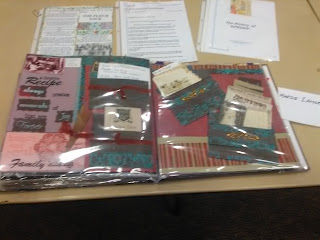
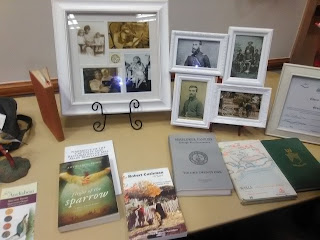
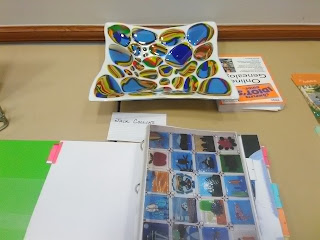
- Art Kelly took pictures of most of the displays at our December meeting, but he may have missed some that left early. Thank you to all who participated. (You can click on the photos to enlarge them.)








Subscribe to:
Posts (Atom)