Showing posts with label DNA. Show all posts

Monday, April 30, 2018

How to Better Determine Relationships of DNA Matches

by Heather Murphy

When looking at DNA matches the various companies give you a general range of possible relations, close relative to first cousin, first cousin to great-nephew/niece, third to fifth cousins, etc.  While this is somewhat helpful, it is also somewhat vague.  Estimating the generational differences between matches and using tools from the Shared cM Project can significantly narrow the possible relationships of DNA matches.

A few weeks ago a "cousin" contacted me through one of the major DNA genealogical companies.  She was a genetic match with my grandmother and wanted to determine their connection.  After a few emails back and forth looking for a common ancestor about four or five generations back she told me her father, Tom (name has been changed), was adopted and she was actually working on finding his birth family.  My grandma's connection with her father was too far back to be of much help with the information she currently had, but I offered to help with her search.

The closest genetic matches for Tom was a first cousin and a great-nephew, per the estimated relationships the DNA testing company suggested. At my request, she sent me the information so I could review it.

The first thing to do with a genetic match is determine the generational difference between the two matches.  In this case, the possible first cousin and Tom were both in their 60s.  The cousin did not have a family tree posted, so I was unable to look at the actual generations moving backward.  While being approximately the same age puts them most likely in the same generation, it is not a certainty.  For instance, my mother was born the same year as her aunt.  However, for the time being my assumption is that first cousins is still a plausible relationship.

With the second match, the supposed great-nephew was in his 30s compared to Tom in his 60s.  In this case I did have access to his parents' information and they were in their 50s.  Most likely there is only one generation between Tom and this match, not the two generations that would be required for a great-nephew.  The age difference would suggest this match is related to Tom by only one generation, meaning one of this person's parents is a possible sibling to Tom.

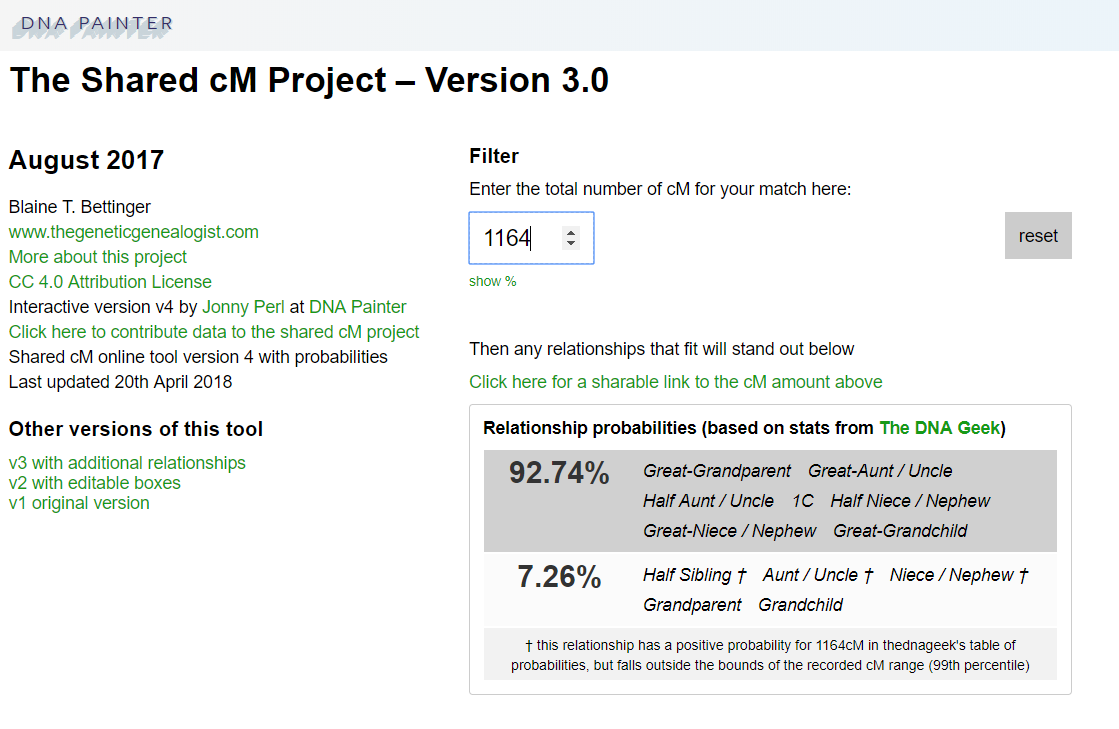
Looking at the generational difference is only the first step.  Next, look at the number of centimorgans (cM) the matches have in common.  Tom and his cousin have 1,164 cM in common.  Take that information to The Shared cM Project, compiled by genetic genealogist Blaine Bettinger, accessed through the DNA Painter website. Input the amount of shared cM and you will receive a chart with the likelihood of certain relationships.  This is what it looked like for Tom and his possible cousin match:
dnapainter.com/tools/sharedcmv4
Since Tom and this match are most likely in the same generation, I look for probable relationships that reflect that.  In this instance, the only relationship that fits that description is first cousin.  Most likely Tom and this match share the same grandparents.

Now look at the second match's results:

dnapainter.com/tools/sharedcmv4
Looking for relationships one generation apart, the only likely option is that the match is Tom's half nephew, meaning one of this match's parents is Tom's half sibling.  By recognizing the generational differences and using this tool we were able to significantly narrow our search for a common relative.

At first, the assumed match was a great-nephew with the information from the testing company.  By looking at generational differences the assumed relationship changed to a nephew. Then, using the shared cM chart, the assumption changed to half-nephew.  This is an excellent example of how estimated relationships can change as we analyze the data regarding a genetic match rather than accepting the DNA company's estimation.

These examples are of matches that share a large number of cM.  In the examples above the amount of DNA shared resulted in a small list of possible relationships with greater than 90% probability.  Amounts of DNA less than 400 cM result in more possible relationships with a lesser degree of probability.  For instance, the chart may provide two groups of possible relationships with each group having a 40% probability.  This process will still help identify relationships with smaller amounts of shared DNA, but it won't necessarily narrow the options as tightly as larger amounts of shared DNA.

These tips are a good place to start when determining relationships between matches, but assumptions at this point are made from statistical probabilities and are not relationships of fact.  Further genealogical research and DNA testing are required to establish relationships with certainty.  With the number of possible common ancestors doubling each generation, using these strategies and tools can help focus your search for DNA matches more effectively by helping you focus on possible generations of common ancestors.


Monday, October 16, 2017

TCGS 2017 Seminar - Understanding Your DNA

by Heather Murphy

We had a wonderful seminar on Saturday presented by Diahan Southard.  Diahan thoroughly explained to over ninety attendees how DNA results can help with genealogy research and also their limitations.  We learned the differences between the various testing companies, how to analyze DNA matches within Ancestry.com and use them to help with specific questions in our family trees, and even had a hands-on workshop.  Thank you to the seminar committee for putting on an excellent event!  Diahan does on-line consulting and has several DNA quick guides available for purchase at www.yourdnaguide.com.

Seminar attendees

Heritage Books provided a wide selection of books for purchase

Diahan's booth was always busy

Thanks to Art Kelly for a wide selection of items for the silent auction


Saturday, August 19, 2017

Tri-City Genealogical Society 2017 Seminar


Tri-City Genealogical Society's 2017 Seminar 
is less than two months away, 
have you registered to reserve your spot?

DNA can be an important tool in your genealogical research.  Not only is it interesting to learn about your general ancestry, but with millions of people participating in various DNA databases the chances are ever increasing of being able to use DNA to find relatives, help extend lines, and break through brick walls.

We invite you to join with us to learn from a national expert and engaging lecturer about using DNA to help you with your genetic genealogy.

Understanding Your DNA

with
Diahan Southard


Saturday, October 14, 2017
9:00am - 3:30pm
  Registration begins at 8:00am

Shalom United Church of Christ
505 McMurray Street
Richland, WA

Topics:
  • Five Tips to Make Sense of Your DNA
  • Let Your DNA Tell Your Story
  • Organizing Your Genetic Genealogy
  • Try Your Hand at Genetic Genealogy

Cost: $40. Register by September 30 to include a syllabus and lunch.
          After September 30, syllabus and lunch will not be included.
          Syllabus will be on sale at the door for $5.

Click here for seminar brochure

Click here to register

Door prizes include FindMyPast annual membership, Genealogy Gems annual membership, RootsMagic 7 software, and several more!

Heritage Quest will also be on site selling genealogy books.

Do you feel that you could benefit from Diahan Southard's personal help?  She is offering 20-minute on-site consultations on Friday, October 13 and Saturday, October 14.  Bring your information and she will help you understand how to navigate your DNA results.  She is also offering a discount on her personal consultation package, which is a 45-minute on-line appointment.  Click here to find out more information and to sign up for your appointment.

Saturday, May 7, 2016

It's A Wrap - Archived Document Contest Winners

This last year we have been entertained and amazed with various entries to the Archived Document Contest. The contest began 1 April 2015 and ended 31 March 2016. The goal of the contest was to prove that not all genealogical records are available online while simultaneously celebrating computerized genealogy.

The contest was open to the public. All that was needed to enter the Archived Document Contest was a scanned image of a document that was not found online. Individuals wanting to enter the contest uploaded these scanned images to the TriCity Genealogical Society Facebook page with an explanation of where the document was found and how it tied into the researcher’s family history.

Each month entries were bundled together and sent to a panel of judges. The judges reviewed each entry and selected one entry as that month’s winning entry. Prizes typically encouraged computerized genealogy and included digitized subscriptions to magazines like Internet Genealogy and Your Genealogy. Other prizes were subscriptions to online databases like Mocavo, Newspapers.com, and Fold3.

True celebration, however, came in the excitement of what was discovered by the documents that were found in offline repositories. As we read the entries we cheered for many tender facts that would not have been discovered by simple queries entered into large databases.

There were a total of 33 entries submitted. The majority of these documents came from family archives, but not necessarily the archives of the home. Many important documents came from collaboration efforts and were provided by relatives who were excited to share their treasures. Here is the breakdown of where documents were found that were submitted to the contest.
·        Family Archives - 13
·        Family History Library and Family History Centers – 9
·        Government records (city, county, and state) – 4
·        National and State Archives – 4
·        Local non-government agencies (funeral homes, museums) – 3

It is important to note the variety of repositories that held information shared in this contest. The Archived Document Contest showed us that when researching family history all of these repositories should be explored.  

All winning entries were automatically entered into a separate contest to determine the winner and runner-up for the full year. The first place prize was a one year subscription to Ancestry.com. A runner- up prize was a one year subscription to Find My Past.

The judging panel had a very difficult job in selecting the two winning entries from a collection of twelve entries that were already deemed superior. They did select Margie Stein Beldin’s entry submitted in April 2015 and Loren Schmid’s entry submitted in February 2016.
Margie Stein Beldin -
Archived Document Contest Winner


You can read Margie’s entry by going to http://tinyurl.com/MSBIreland or you can read the TCGS blog article about her entry at http://tcgs1961.blogspot.com/2015/05/archived-document-contest-april-winner.html. She shared with us her struggle of reading old handwriting found on a preprinted form. In her search she collaborated with other researchers, asked assistance from an expert genealogist, kept her research current by reading various publications, and emailed the National Archives. She never gave up and she was rewarded with her 2nd great grandfather’s Declaration of Intent. She is also awarded a one year subscription to Ancestry.com. The judges felt that Margie had used many traditional research methods in order to fulfill her quest.

Loren Schmid -
Archived Document
Contest Runner-Up
Loren Schmid, on the other hand, won the runner-up prize for using more modern techniques. In his February 2016 entry he shared how DNA research opened up many doors. You can read his entry by going to blog article about her entry at http://tinyurl.com/zwo6l4k. There is a TCGS blog article about Loren’s entry at http://tcgs1961.blogspot.com/2016/03/susan-davis-faulkner-to-purchase.html. Loren shared with us the success that can be found by using DNA to find researchers to collaborate with. He also gave us wonderful examples of how collaboration can be enjoyed and reciprocated.   


Thank you to everyone that participated in this contest. Those that submitted entries helped us to learn from their success stories. A huge Thank You goes to our panel of judges. Their input was essential to the success of this contest. The Judges were Bill Floberg (Chairman), Mary Kay Walker, and Walt Wood.


Tuesday, April 19, 2016

Finding Our Way through the DNA Maze

By TCGS Member, Connie Estep

Genetic genealogy uses DNA testing along with traditional genealogy, but it cannot replace
traditional methods. It can add an incredibly useful dimension to traditional genealogy. Margie Beldin and Marianne Orton titled their April meeting program “A Taste of Genealogy.” Their “taste” led us through more science than many of us have seen in years!


The reason for so much science is that there are three kinds of genealogy tests available. To find what we are looking for we need to know what each test can and cannot do. There are also limits to what the tests can find. The more we know about the science behind DNA, the better we can tailor it to our research needs. DNA testing is just one more tool in our genealogy research toolbox.

There is much more to absorb about DNA than can be done in an evening program but Margie and Marianne provided a handout to help that process. It includes sources for written and video formats. If you missed the meeting you will find the handout on the TCGS website (click here to go to the “Meetings and Events” page).

Ethnicity testing is available from all three tests. Autosomal DNA (atDNA) not only suggests your ethnicity but could possibly also find relatives within five generations (for relatives that are also in the database). This test is for both the mother’s and the father’s lines.

Testing of mothers’ lines is done from mitochondrial DNA (mtDNA). Unlike the autosomal, it doesn’t stop at five generations but goes all the way back to deep ancestry. It is the same for fathers’ lines, done from Y chromosome testing (Y-DNA, or guY-DNA).

Something to remember is that we only get half our DNA from each parent. If it is still possible to have your parents tested that is of prime importance. If that is not an option find a sibling or cousin to test or your mother's sisters or your father's brothers. The more people tested in your family the better the results will be because DNA must be compared with others’ DNA to find the links in our ancestry. Testing of the maternal and paternal lines requires direct descendants. If you are female, you would need yourself for your mother’s line and your brother for your father’s. If no siblings are available then aunts, uncles, cousins are another option. Grandchildren would also work but there would be even less of your parents' DNA.

Testing is available from Ancestry, Family Tree DNA, and 23andMe. See the handout (click here to go to the “Meetings and Events” page) for links to their websites. The meeting was well attended with 61 people.


Monday, March 7, 2016

Susan Davis Faulkner to Purchase “History Magazine” Subscription

February’s Archived Document Contest only had two entries but they were packed with points to consider when researching. Susan Davis Faulkner submitted a copy of a birth register that she obtained from the Family History Library in Salt Lake City. Her great-grandmother was listed but without a first name and with a variant spelling of her surname. If Susan had relied strictly on one surname spelling she would have overlooked this important document.

Loren Schmid shared a wonderful success story that began with a DNA test. This test connected him with a researcher of two second cousins who had many documents to share. In return Loren shared a family reunion. The emphasis of Loren’s success came from collaborating with not only another researcher but also by reminiscing with living family members. He asked questions which validated the claims made by documents that were discovered.

Loren is the winner of the February contest, and he has won a subscription to History Magazine. History Magazine is a consumer magazine covering social history, in particular the day to day life of ordinary people. Loren probably has some interesting stories that he can submit to this magazine. Susan, on the other hand, plans on purchasing her subscription.

There is still time to enter the contest. March is the last month of this one-year Archived Document Contest. The winning entry for March will get a one year subscription to Fold3. Fold3 provides convenient access to US military records, including the stories, photos, and personal documents of the men and women who served. Once the winner for March’s contest is announced all winning entries will be entered into a final contest. There are two Grand Prizes. They are subscriptions to Ancestry.com and Findmypast.

To enter the contest upload a copy of a document that you obtained in any method other than downloading from the Internet to the TriCity Genealogical Society Facebook page. Include how you obtained the document and how it ties into your family history research. Entries can also be sent to Susan Davis Faulkner at denmother4@hotmail.com


Thursday, December 12, 2013

Brick Wall Headache Relief

I probably learn more about how to research my family’s history by chit-chatting with genealogy friends than any other method. I love hearing their success stories, but I get much more out of hearing about their search struggles. Each step along their journey is important to me. As I listen to them explain their adventures I learn about techniques they have tried, and new repositories they have explored. Many times their stories are mere vents of frustration but usually there are juicy gems embedded along their journey’s path.

Tonight at the TriCity Genealogical Society meeting I was entertained and educated by two very dear friends, Sandra Floberg and Bob DeLorenzo. Janet McKinnon introduced Sandra as our “Southern Lady”, so she was given the opportunity to speak first, allowing our “Italian Gentleman”, Bob DeLorenzo, to wrap up the evening.

Sandra has been one of those close genealogy friends that I have the honor of interacting with quite frequently. I was not at all surprised that she was going to talk about her John Worth Meacham – again.  Her presentation started with the general list of questions that all genealogists should ask when they begin their hunt for information. She then proceeded to explain what she had done to try to unravel her quagmire of Meachams and Worths that all enjoyed the same naming patterns and had adopted the name of John Worth Meacham for generations, overlapping not only generations within their own family but also generations of neighboring John Worth Meachams.

Sandra shared how she had finally explored the use of DNA testing, and had taken results from other companies to combine the results into Family Tree DNA ( http://www.familytreedna.com/ ). She explained how hopeful she had been that by using yet another company to match results she might gain answers to questions she had worked on for so many years.

As a friend, and as an attendee at the TriCity Genealogical Society meeting, I was shocked when Sandra shared that even with DNA testing she was not able to determine the parentage of John Worth Meacham. She admitted that there was not yet enough DNA samples, and that she would have to walk away from her chase. Not only was I shocked, but I was saddened. Now what would she possibly have to share with her genealogy friends? I felt as if I was experiencing the death of a decade.

What transpired next shook my world and was a true revelation. Sandra shared a census record showing her John Worth Meacham and his wife, Elizabeth Allen, which also held clues for Sandra to begin researching Elizabeth Allen’s lineage. For years she had worked on John Worth Meacham, but when she finally walked away from that particular chase and began working on his wife’s lineage the doors started to open.

Sandra has found a new peace. She is comfortable waiting for answers on her John Worth Meacham. By following his wife’s lineage she has been able to add two more Revolutionary Patriots to her family tree. That is a pretty amazing accomplishment and a big bonus as she serves as Regent for the Kennewick Chapter of the Daughters of the American Revolution.

Bob DeLorenzo then got up to speak. I love listening to Bob’s comfortable speaking style and was so glad he had agreed to speak at tonight’s meeting.

Bob began by giving an introduction to the Mayflower Society. He explained a little about their history and read the Mayflower Compact. He then shared the story of how he and his deceased wife, Nancy, got involved with genealogy and Nancy’s desire to join the Mayflower Society.

After joining the Mayflower Society, Nancy decided that she wanted to prove that she had another lineage that was connected to the Mayflower, to Pilgrim Francis Eaton. When Nancy and Bob started digging through the Silver Books, which are books full of information about Mayflower descendants, they found the initials n.f.r. after Francis Eaton's descendant Sarah Ramsdell, which stands for "no further records"!!  Nancy had an ancestor named Sarah Ramsdell, and she was persuaded that her Sarah Ramsdell was the same person as Francis Eaton's descendant with that name, but how could she prove it?

Bob shared how he and Nancy had used logic to determine that Sarah and her sister Lydia, (who also had n.f.r. after her name in the Silver Book), and their mother, had moved to a neighboring town after the death of Sarah's (and Lydia's) father, Thomas.  There were no records to prove this move, but logically it could be explained. This was presented to the Mayflower Society, but Nancy’s supplemental application for Francis Eaton was denied. This was heart breaking, but Bob acknowledged that the denial was proper since there were no documents to prove their theory that Nancy's Sarah Ramsdell, and Francis Eaton's descendant, Sarah Ramsdell, were the same person.

After Nancy’s death Bob continues to work on proving Sarah (and Lydia) Ramsdell, and their mother, relocated, and he hopes that the documentation to prove his logical explanation will lay in records left my Sarah and Lydia's mother’s employer, a judge. He has searched probate records and now plans on looking for personal memoirs or social history left by the judge’s family.
A startling discovery was shared about an heirloom spinning wheel that is showcased in the DeLorenzo home. The spinning wheel has been appraised by professionals. It is in great condition for its age, however its age has not been determined. While researching probate records Bob came upon a Last Will and Testament dated before the Revolutionary War. In the Will one of the daughters was listed as not being left anything, but not being overlooked either. She had been given a spinning wheel before the Will was written. By finding this probate record, Bob was able to date the spinning wheel that sits in his living room to a preRevolutionary War timeframe.

I left the meeting feeling appreciative of the gems Sandra and Bob freely gave. No longer will I beat my head against my own brick wall, but rather look at how my brick wall ancestor integrates in his wife’s family documents. By doing this maybe I can find a couple more Revolutionary War patriots, or even my own Mayflower connection.