Showing posts with label Margie Stein Beldin. Show all posts

Saturday, May 7, 2016

It's A Wrap - Archived Document Contest Winners

This last year we have been entertained and amazed with various entries to the Archived Document Contest. The contest began 1 April 2015 and ended 31 March 2016. The goal of the contest was to prove that not all genealogical records are available online while simultaneously celebrating computerized genealogy.

The contest was open to the public. All that was needed to enter the Archived Document Contest was a scanned image of a document that was not found online. Individuals wanting to enter the contest uploaded these scanned images to the TriCity Genealogical Society Facebook page with an explanation of where the document was found and how it tied into the researcher’s family history.

Each month entries were bundled together and sent to a panel of judges. The judges reviewed each entry and selected one entry as that month’s winning entry. Prizes typically encouraged computerized genealogy and included digitized subscriptions to magazines like Internet Genealogy and Your Genealogy. Other prizes were subscriptions to online databases like Mocavo, Newspapers.com, and Fold3.

True celebration, however, came in the excitement of what was discovered by the documents that were found in offline repositories. As we read the entries we cheered for many tender facts that would not have been discovered by simple queries entered into large databases.

There were a total of 33 entries submitted. The majority of these documents came from family archives, but not necessarily the archives of the home. Many important documents came from collaboration efforts and were provided by relatives who were excited to share their treasures. Here is the breakdown of where documents were found that were submitted to the contest.
·        Family Archives - 13
·        Family History Library and Family History Centers – 9
·        Government records (city, county, and state) – 4
·        National and State Archives – 4
·        Local non-government agencies (funeral homes, museums) – 3

It is important to note the variety of repositories that held information shared in this contest. The Archived Document Contest showed us that when researching family history all of these repositories should be explored.  

All winning entries were automatically entered into a separate contest to determine the winner and runner-up for the full year. The first place prize was a one year subscription to Ancestry.com. A runner- up prize was a one year subscription to Find My Past.

The judging panel had a very difficult job in selecting the two winning entries from a collection of twelve entries that were already deemed superior. They did select Margie Stein Beldin’s entry submitted in April 2015 and Loren Schmid’s entry submitted in February 2016.
Margie Stein Beldin -
Archived Document Contest Winner


You can read Margie’s entry by going to http://tinyurl.com/MSBIreland or you can read the TCGS blog article about her entry at http://tcgs1961.blogspot.com/2015/05/archived-document-contest-april-winner.html. She shared with us her struggle of reading old handwriting found on a preprinted form. In her search she collaborated with other researchers, asked assistance from an expert genealogist, kept her research current by reading various publications, and emailed the National Archives. She never gave up and she was rewarded with her 2nd great grandfather’s Declaration of Intent. She is also awarded a one year subscription to Ancestry.com. The judges felt that Margie had used many traditional research methods in order to fulfill her quest.

Loren Schmid -
Archived Document
Contest Runner-Up
Loren Schmid, on the other hand, won the runner-up prize for using more modern techniques. In his February 2016 entry he shared how DNA research opened up many doors. You can read his entry by going to blog article about her entry at http://tinyurl.com/zwo6l4k. There is a TCGS blog article about Loren’s entry at http://tcgs1961.blogspot.com/2016/03/susan-davis-faulkner-to-purchase.html. Loren shared with us the success that can be found by using DNA to find researchers to collaborate with. He also gave us wonderful examples of how collaboration can be enjoyed and reciprocated.   


Thank you to everyone that participated in this contest. Those that submitted entries helped us to learn from their success stories. A huge Thank You goes to our panel of judges. Their input was essential to the success of this contest. The Judges were Bill Floberg (Chairman), Mary Kay Walker, and Walt Wood.


Friday, April 22, 2016

2nd Genealogy Class: The Research Process, April 13, 2016

By TCGS Member, Connie Estep

Now that we have recorded all the family information we know, it’s time to begin the research process. With the wealth of information on the internet it is very easy to get sidetracked. That’s why we need a plan before we start. Instructor Margie Beldin provided a detailed outline for making that plan in her handouts available at the TCGS website (click here to go to the Education page).

Her advice is to work on one family at a time and include all family members, their friends, associates, and neighbors (the F.A.N. Club). Margie included a worksheet template for recording our research plans. Besides working on one family at a time, Margie says we should limit the research to one individual in the family and one specific question at a time. Here again this will keep our research from getting sidetracked on rabbit trails. She suggests we pick off the easiest objectives first.


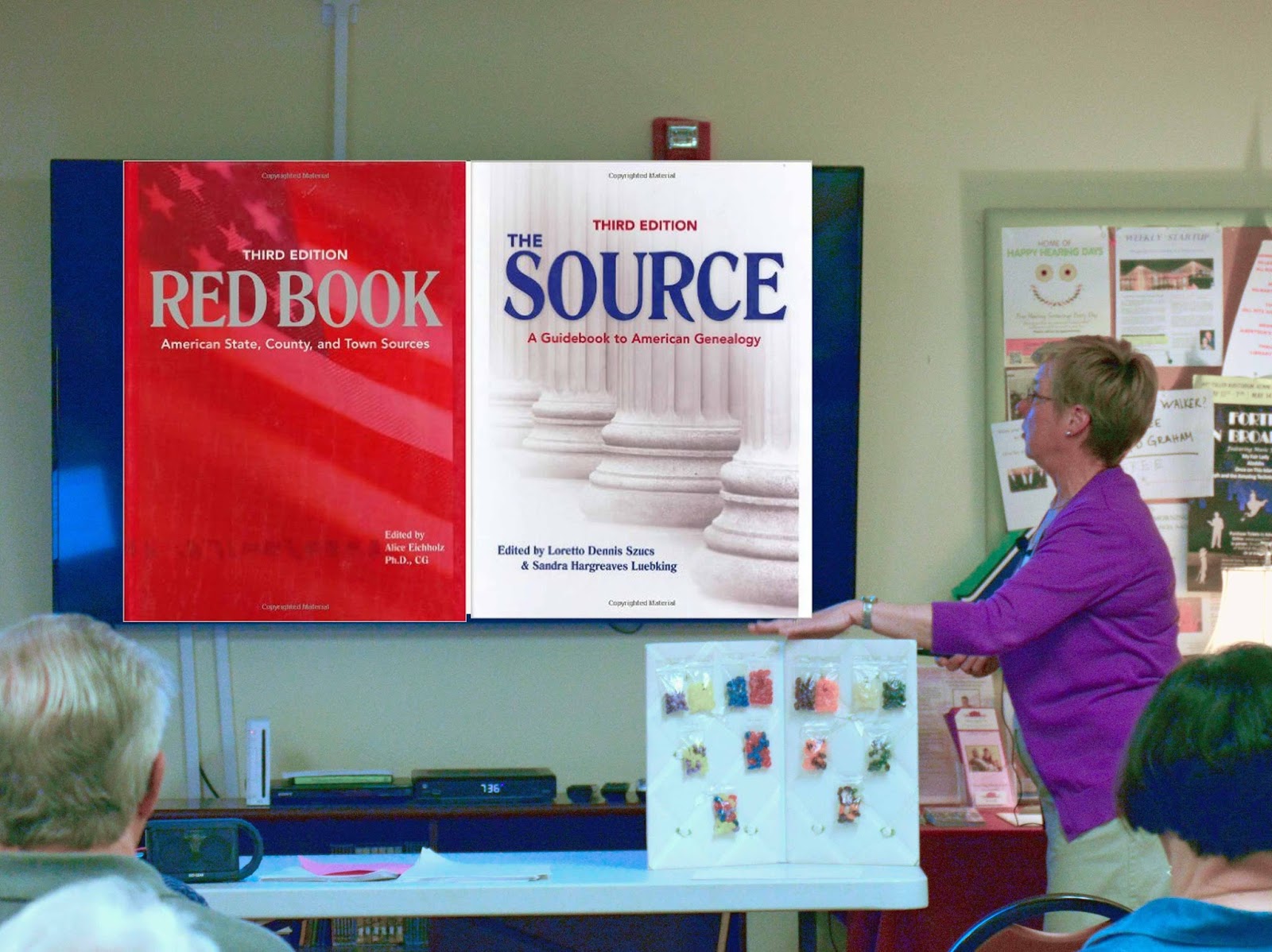
A little time spent planning where to search can help this process. Margie provided a copy of the U.S. Record Selection Table with sources for life events. She brought a copy of the book The Source: A Guidebook of American Genealogy, Third Edition (the latest version) by Szucs & Luebking containing just under 1000 pages of resources. Both Richland and Kennewick Family History Centers have copies of this. Kennewick may have the latest version but Richland does not. Ancestry.com Family History Wiki has the latest version available to anyone.

It also helps to learn about records in the places your family members lived. The Ancestry.com Family History Wiki also has the Red Book: American State, County, and Town Sources. Red Book is organized by state and is very easy to use. It led me quickly to my mother’s California birth record (I knew the date and town) and the information that birth records were not kept in Kentucky when my father was born. The Kennewick F.H.C. also has the Red Book.

The research plan template in our handout is a place to record the family and person we will research and what we want to know about them. (Remember, one question at a time!) Adding the sources we want to check will make it easier to focus our research. I’ve found this especially helpful when I’m going to the Family History Center or to Yakima for research.


The Beginning Genealogy classes are scheduled through December (except July and August) before monthly TCGS general meetings from 6:15-6:45 p.m. This second class was attended by 26 people and gave me great ideas for my research. The 3rd session of Beginning Genealogy will be on Recording and Sourcing. Don’t miss it!

Tuesday, April 19, 2016

Finding Our Way through the DNA Maze

By TCGS Member, Connie Estep

Genetic genealogy uses DNA testing along with traditional genealogy, but it cannot replace
traditional methods. It can add an incredibly useful dimension to traditional genealogy. Margie Beldin and Marianne Orton titled their April meeting program “A Taste of Genealogy.” Their “taste” led us through more science than many of us have seen in years!


The reason for so much science is that there are three kinds of genealogy tests available. To find what we are looking for we need to know what each test can and cannot do. There are also limits to what the tests can find. The more we know about the science behind DNA, the better we can tailor it to our research needs. DNA testing is just one more tool in our genealogy research toolbox.

There is much more to absorb about DNA than can be done in an evening program but Margie and Marianne provided a handout to help that process. It includes sources for written and video formats. If you missed the meeting you will find the handout on the TCGS website (click here to go to the “Meetings and Events” page).

Ethnicity testing is available from all three tests. Autosomal DNA (atDNA) not only suggests your ethnicity but could possibly also find relatives within five generations (for relatives that are also in the database). This test is for both the mother’s and the father’s lines.

Testing of mothers’ lines is done from mitochondrial DNA (mtDNA). Unlike the autosomal, it doesn’t stop at five generations but goes all the way back to deep ancestry. It is the same for fathers’ lines, done from Y chromosome testing (Y-DNA, or guY-DNA).

Something to remember is that we only get half our DNA from each parent. If it is still possible to have your parents tested that is of prime importance. If that is not an option find a sibling or cousin to test or your mother's sisters or your father's brothers. The more people tested in your family the better the results will be because DNA must be compared with others’ DNA to find the links in our ancestry. Testing of the maternal and paternal lines requires direct descendants. If you are female, you would need yourself for your mother’s line and your brother for your father’s. If no siblings are available then aunts, uncles, cousins are another option. Grandchildren would also work but there would be even less of your parents' DNA.

Testing is available from Ancestry, Family Tree DNA, and 23andMe. See the handout (click here to go to the “Meetings and Events” page) for links to their websites. The meeting was well attended with 61 people.


Monday, April 11, 2016

Filling in the Holes, Beginning Genealogy Classes

By TCGS Member, Connie Estep 

Most of us learned genealogy a little at a time as we pieced together our family histories. I started that way about 2 ½ years ago but found this left holes in my background. Margie Stein Beldin gave us an organized way to begin research in this first Beginning Genealogy class on 9 March 2016.

Identify Known Family Information was the March topic. Margie provided sample forms as a starting place. These are available at the TCGS website (click here to go to the Education page). The computer will be a major tool in our research with genealogy software access and on-line searching capabilities.
TCGS Education Chairperson,
Margie Stein Beldin


The second step is to record what you know about your family; she provided a form to free-flow family details. There is also an LDS booklet for recording the same kind of information. You can order this booklet at the FamilySearch.org website in the 
My Family link.  The third step is to look through your house for family history records. I think many people would be surprised at the records they already have on hand. She also gave us a checklist of documents we might find in our homes.

The nitty-gritty of genealogy is recorded on pedigree charts for multiple generations, and family group records for details of one couple and their children. As you gather information and complete pedigree and family group records you need to think about organization. That was a major hole in my background as I’d gathered a number of documents and it became hard to locate information in the pile. Margie recommended we make a loose-leaf notebook for each of our parents. This can solve the “pile” problem.  I’ve found that a pile will avalanche once it reaches critical mass!

The Beginning Genealogy classes are scheduled through December before monthly TCGS meetings from 6:15-6:45 p.m. This first class was well attended and gave me great ideas for my research.

Sources:
(or the Education tab on the TCGS website)

https://familysearch.org/myfamily (My Family tab on the FamilySearch website)


Monday, February 1, 2016

New Member's Orientation on January 27th

There was New Member’s Orientation for TriCity Genealogical Society members on January 27th. It was well attended and a lot of fun. Pamela Keller is not only a new member but also the TCGS Historian. We are thrilled to share Pamela’s comments in her first blog contribution below.
 
"Being a new or prospective member of any organization can be a bit intimidating – meetings to attend, new faces and names, more time out of an already full schedule. Or, so I thought … until I had the pleasure of attending the TriCity Genealogical Society’s New Member’s Orientation on 27 January at the Richland Family History Libraries. Attendees were provided a packet prepared by the chapter leadership with an outline of the many resources available to us as members of TCGS.  There is a chapter website, bulletin, Facebook page and Blog. We also have access to the Richland Family History library, where the society’s 3000+ library books, CDs, Microfiche and microfilm are housed. Volunteer librarians are always welcoming and helpful.
There are many reasons why each of us made the decision to join TCGS.  For me, I want to ensure I am honoring my ancestors by collecting accurate information, researching, organizing and protecting the collection as best as I am able for our descendants.  I am inspired and encouraged by the members I’ve met in our local chapter, and appreciate their willingness to enthusiastically share their knowledge of genealogy.
Thank you to the TCGS Board members for offering a New Member’s Orientation, with a special thank you to President - Walt Wood, Publicity Committee Chairperson -  Susan Faulkner, Education Committee Chairperson - Margie Belden and Library Committee Chairperson - Sandra Floberg."


Saturday, November 14, 2015

We Are All Winners in the October Archived Document Contest

The Archived Document Contest is a monthly contest to showcase what can be found when we explore beyond what is available online. Those that enter the contest share what they have discovered, how they have discovered it, and how it relates to their family history research. In October we learned that there are methods to get information when the records are not available. We also got insight into fascinating aspects of some ancestor’s personalities that were revealed when researchers explored past indexes and transcriptions.

John Covey shared with us that his request for his aunt’s birth certificate was denied because he was not a direct descendant. What he received from the Tennessee Office of Vital Records instead of a birth certificate was an extraction of the information that the official document contained. This included the date, time, and location of his aunt’s birth along with detailed information about her parents and their background. We always want original records but when they are restricted there are often other ways to obtain juicy tidbits of information.

Linda Stephens provided a copy of her grandmother’s marriage certificate. The original document had holes in it caused by an eraser where the ages of the bride and groom were once recorded. By looking at the original document it was obvious that the 28-year age difference must have been a concern to someone.

Margie Stein Beldin entertained us with her story of her research trip to Scotland. After days of looking for information about her great-grandfather she hit a goldmine on the last day of her trip. She had poured through many collections at the UK National Archives before it was suggested that she visit the Scots Guard Barracks archivist. She was presented with a huge file folder of information pertaining to her great-grandfather. Included in the folder were his enlistment and discharge records which included his birth date and place, parents’ names, and religion. In addition to the information she expected to find she also was provided with his physical description, his health history, and reports of his drunken behavior.

Loren Schmid educated us with his research report disproving a family legend about his great-aunt’s father-in-law. This man was said to have been so tall that he hit his head on a barn while riding a horse and that he had sustained an injury that gave him a mental disorder. Searching through various Civil War military records, vital records, historical biographies, and even grave markers Loren ascertained that this man was actually 5 foot 2 inches and died of senility contributed to by arteriosclerosis.

We can all claim to be winners in this month’s contest. The examples and lessons learned provide us with an astounding amount of information to let us know that personalities of our ancestors are recorded and can be found when we leave the Informational Highway titled the Internet. The judges had plenty of material to consider before making the decision on which of the entries would win the TriCity Genealogical Society membership which was the prize for the October contest. They finally concurred that Loren Schmid and his discovery of his great-aunt’s height-challenged father-in-law was the winner. Loren was honored at the TriCity Genealogical Society Annual Meeting with a certificate stating that he had won an annual membership. Loren stated that since he had already paid his 2016 dues he would like for the money slated for the prize to be donated to the Wreaths Across America project. More information about this project can be found at www.wreathsacrossamerica.org


Loren Schmid accepting certificate for winning
October Archived Document Contest
 from John Covey, President
November’s contest is underway. Enter your story for an opportunity to win a free 2-hour consultation with Stories to Tell Books. Stories to Tell Books assist authors in any and all steps necessary to publish manuscripts.  Need some technical advice? Want an editor to look over your work? Check out Stories to Tell Books at www.storiestotellbooks.com.  Better yet, submit your entry to the November Archived Document Contest. Upload a family history related document to the TriCity Genealogical Society Facebook page at www.facebook.com/TriCityGenealogicalSociety Include how you obtained the document, which can be any method other than downloading from the Internet. Also explain how it pertains to your research. All monthly winners will be entered into a separate and special contest for the Annual Archived Document Contest with prizes to Ancestry.com and Findmypast.com

Tuesday, July 7, 2015

June's Archived Document Contest Unanimous Winner

The month of June 2015 provided the Archived Document Contest with a wealth of information. We discovered more locations for important documents. We also enjoyed the stories that encouraged us to go beyond the Internet to find gems of our own family’s history.

In June we learned that Civil Servants, even when burdened with their own workload, can be a valuable connection. Margie Stein Beldin received information about her great grandparents’ marriage registration which also included her great great grandfathers’ name. This opened up a new generation of family information for her. We also got to mentally visit cemeteries and research libraries with Jan Norman as she told her story of finding letters between her third great grand uncle and his Civil War active military nephews. Marian Beecher Halverson and Susan Davis Faulkner shared additional stories of photographs and documents provided by family members. This reminded us of the vast amount of information contained in family collections.

Jan Norman and her cousin, Jim Cunningham
The Judging Panel voted unanimously that Jan Norman’s trip to the Working Man’s Institute and Library in New Harmony, Indiana walked away with the June prize for the Archived Document Contest. Jan Norman’s “feet on the ground” research provided incredible and personal information about her family in 1863. The letter that Jan submitted was full of details of what her ancestors experienced while fighting in the war.
Go to the TCGS Facebook page to read the entire letter.


Page Two of the Schnee Civil War Letter


Jan wins a one year subscription to Backblaze. Backblaze provides continual online backup service so Jan won’t have to stop her important work to save those valuable files.


July’s Archived Document Contest is currently underway. Upload a digital copy of a document you acquired in any method, other than downloading, to the TriCity Genealogical Society Facebook page to enter. July’s prize is a free registration to the Traveling Through Time Seminar scheduled for September 12, 2015 in Richland. William Dollarhide is the speaker. For more information on the seminar go to www.tricitygenealogicalsociety.org. To check out the current Facebook entries, or to enter, go to https://www.facebook.com/TriCityGenealogicalSociety

Saturday, July 4, 2015


Photo by Roxanne Lowe

Here are some of the people from TCGS that attended the Washington State Genealogical Society conference in Ellensberg with speaker David Rencher.   L to R – a friend, Renee Petersen, Veronica Anguiano, Hank Jackel (standing), Margie Belden and Mary Ann Orton.
At this conference Veronica Anguiano and Margie Belden were awarded WSGS Recognition awards for which TCGS had nominated them.

Veronica Anguiano 

Veronica was recognized for her outstanding efforts in the cataloging of historical documents of importance and value to researchers interested in Benton and Franklin Counties.

Veronica Anguaimo has been selected by the Tri-City Genealogical Society (TCGS) as their recipient of the WSGS Outstanding Volunteer Award. She was selected for her commitment to researching and sharing information, even outside her local Society.

Ms. Anguiano has distinguished herself in untiring support of the TCGS as its Research Chair and helping research Benton and Franklin county histories. Ms. Anguiano has responded willingly and efficiently to numerous requests for information from outside her local society.

Ms. Anguiano has become heavily involved in re-cataloging the TCGS library holdings so the holdings can be searched from the FamilySearch Library Catalog. As the holdings are re-cataloged, the new numbers are uploaded to the FamilySearch system, making them searchable from FamilySearch’s online site.

Ms. Anguaimo is a respected and diligent member of the TCGS, and richly deserves this recognition.

Margie Belden

 Margie was recognized for exceptional and consistent support of the goals and operation of the Tri-City Genealogical Society.

Margie Beldin has been selected by the Tri-City Genealogical Society (TCGS) as their recipient of the WSGS Outstanding Volunteer Award. She was selected for her dedicated, enthusiastic efforts to educate members of her local Society.

Ms. Beldin has distinguished herself in untiring support of the TCGS as its Education Chair for many years.  In that position, Ms. Beldin has made many classes on a wide variety of subjects available to the membership. Ms. Beldin has not only coordinated setting up classes and programs, she has taught numerous classes herself, as she actively increases her knowledge and capability through attendance at genealogical conferences and classes outside the TCGS. She is always willing to share the knowledge that she gets from these events.

Ms. Beldin is a valued and hard-working member of the TCGS, and richly deserves this recognition.


Sunday, May 10, 2015

Archived Document Contest April Winner Announced

The TriCity Genealogical Society’s Archived Document Contest began April 1. There were a total of six entries during the month. Facebook readers stood by with anticipation as entries were made from individuals who had found wonderful family gems off line. Four of the entries posted during the month were received from family members, one from a microfilm at the Family History Library, and another one by making a telephone call to the National Archives Branch in Boston.

Flavor of life unfolded before our eyes as we learned that succulent details of ancestors’ lives were available, but not in huge databases. We got to enjoy pages from a personal journal, a holiday card with an important announcement, and an article written by an 11 year old boy that was published in a national magazine. The information shared in these artifacts helped the researchers enjoy a more personal understanding of their ancestor.

We also got to enjoy the more standardized genealogical finds like naturalization declarations, citizenship applications, and newspaper clippings. The ones shared during the contest though were not digitized. Many times the researcher had to work a little harder to obtain the information they were seeking, but the rewards were well worth the exploration.

If the results from this month’s contest were going to recommend the repository with the best results, family members would win. This should encourage all of us to seek information from our own family member repositories. This contest however is for the best submitted document that was obtained in any fashion other than the Internet.

Our winner for the month of April is Margie Stein Beldin. The final step in Margie’s long adventure in obtaining the Naturalization Declaration of her 2nd Great Grandfather was a phone call to the National Archives Branch in Boston. Margie wins a one year Premium Membership to Lisa Louise Cooke’s Genealogy Gems. You can get more information about this prize by going to www.GenealogyGems.com


Below is what Margie submitted about her amazing search for information and how she was able to obtain results.

” More than 15 years ago, I found the naturalization papers for my Irish gr gr grandfather, Frances McCue. However, it was impossible to decipher the name of the county he came from. I knew little about Irish research except that you had to know at least the county to begin researching in Ireland.
In 2001, I attended my first national conference, NGS-Portland. Wanting to know more about Irish research, I attended several presentations by Irish genealogists. Kyle Betit was one of them. I explained to him my dilemma and he offered to look at the naturalization document to see if he could decipher the place.
Before I turned to Kyle, however, I decided to try again on my own. The naturalization papers did show that Francis had filed his Declaration of Intent 24 June 1851. In 2002, I went to Boston for the first time and met a cousin, Patricia McHugh, who wanted to help me search for our Irish ancestor. She and I drove to Waltham to NARA-Boston to look through the books ourselves. However, we met with disappointment when we found a gap in the documents surrounding the time Francis would have filed his declaration. We left frustrated.
I then turned to Kyle who tried to read the county but could not decipher it. Pat even took a copy of the naturalization paper to Ireland on vacation. People there said the place had to be Lahinch. The problem was, Lahinch is not a county but a town. I didn’t buy that explanation at all.
In 2012, I was reading the Berkshire Genealogist, a publication of the Berkshire Family History Association. Their local librarian wrote about locating naturalization records. This led me to try once again to find the declaration of intent. I sent an email to NARA-Boston with a copy of what I did have and an explanation about not finding the declaration back in 2002.
Within days of my email I received the following email: “The declaration of intent for Francis McHugh has been located. We can provide a copy of the record for a fee of $7.50 per record...” Needless to say, I was on the phone in minutes reading them my credit card number. Within a few days, I received the declaration in the mail and there, in bold, legible handwriting, it said “County Leitrim, Ireland”. It was time to do the genealogy Happy Dance!

It only took 12 years+ and I still do not know the exact birth place of Francis McCue or if any of his family survived the famine besides him, but I’m one step closer. And, lucky for me, County Leitrim is one of the smaller counties.”